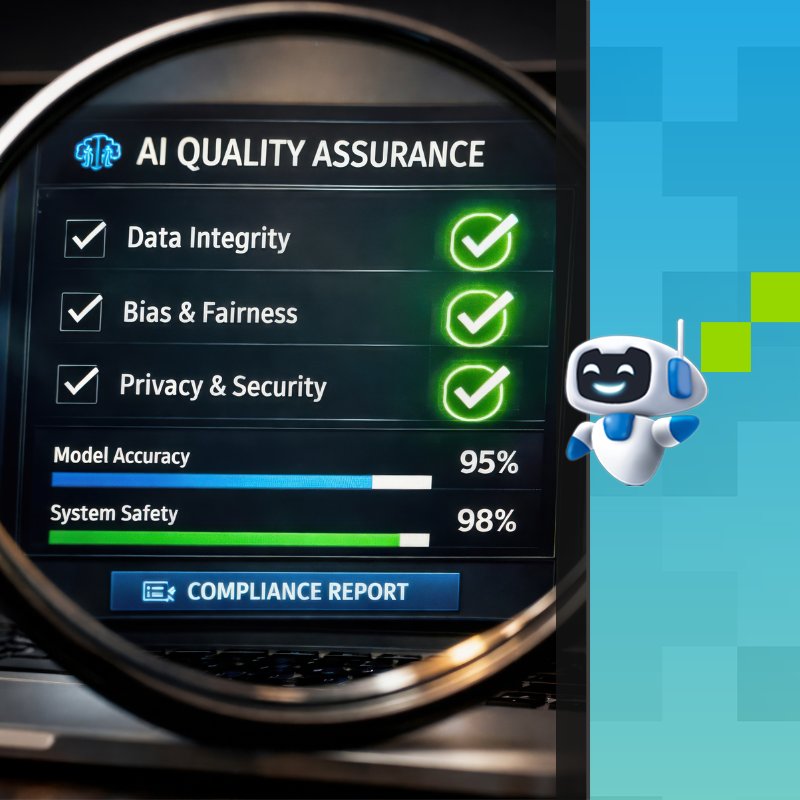
Why AI Projects Fail Before They Start: Diagnosing Your Data Readiness Gap When it Comes to AI Data Quality

Part of the AI Readiness Series
Key Takeaways
- The most common AI project failure is not technology failure; it is deploying on data too inconsistent for AI to generate reliable recommendations.
- MIT Technology Review found that 45% of C-suite leaders cite data integration as the top AI readiness obstacle. Meanwhile, 87% of executives believe their data is ready while 84% of practitioners spend hours daily compensating for data quality problems.
- That gap, executive confidence versus practitioner reality, is the core issue. AI exposes the inconsistencies that skilled employees have been quietly absorbing for years.
- Comprehensive data governance before deployment is too slow for mid-market companies. The right approach: targeted cleanup for the specific use case, to “good enough” for that use case, then deploy and learn.
- BCG found top-performing firms achieve five times greater financial impact from AI than laggards. The differentiator is data infrastructure, not model selection or prompt sophistication.
The first three foundations, clear direction, safe usage and trained teams, establish the organizational conditions for AI success. The fourth is technical, and it frequently overrides the other three: if the data AI depends on is unreliable, none of the organizational preparation matters. The AI makes wrong recommendations, employees stop trusting it and adoption collapses regardless of how well everything else was set up. When data issues surface during deployment, the problem is rarely the AI itself but inconsistent AI data quality across core systems.
Here’s a scenario that plays out in hundreds of mid-market companies every year. The AI-assisted collections project launches. The AI pulls customer data from Salesforce, payment history from NetSuite and contract terms from Dropbox. It generates recommendations: which accounts to prioritize, what to communicate, when to escalate.
The collections team opens the first recommendation and checks the underlying data. Customer “Acme Corp” appears as “ACME Corporation” in NetSuite, “Acme Corp.” in Salesforce and “Acme” in contract PDFs. Each of these records has different credit terms, different contacts and different payment history. The AI can’t reliably match them and every recommendation requires manual verification before anyone will act on it. The team spends as much time checking AI output as they would have spent doing the work manually.
Time savings: zero. Project outcome: abandoned.
The technology performed exactly as designed. The failure was organizational, specifically the data foundation the AI was built on.
AI adoption raises the same set of questions across organizations: what’s ready, what’s not, where to start and what actually delivers value. Get the FAQs.
The Data Problem Nobody Wants to Name
MIT Technology Review Insights’ 2024 survey of 300 C-suite leaders found that 45% cite data integration and pipelines as the number one obstacle to AI readiness, and 77% say integration has been a significant challenge. Capital One’s 2025 AI Readiness Survey found a striking gap: 87% of executives believe their data ecosystem is ready for AI at scale. Meanwhile, 84% of technical practitioners report spending hours every day fixing data issues. (Both figures are cited in Querio’s 2025 analysis.)
That gap, executive confidence versus practitioner reality, is the core of the data problem. Companies deploy AI believing their data is ready because the people closest to the data have been quietly fixing its problems every day without surfacing them as systemic issues.
When AI arrives, it exposes those problems immediately and at scale. The AI can’t quietly compensate the way a skilled employee can. It either matches the records or it doesn’t.
The Four Layers of Data Readiness
Data readiness isn’t binary; it’s not “data is ready” or “data is broken.” It operates at four levels, each of which can be more or less mature independently.
Enterprise level: Data governance.
Who owns each type of data? Where is the authoritative source? What happens when data conflicts between systems? Without clear governance, every data conflict requires a human decision. AI can’t make those decisions reliably because it doesn’t know which system is authoritative. The result is that every AI recommendation that touches cross-system data requires manual verification, eliminating most of the value.
Example of working governance: Customer financial records live in the ERP. Sales relationship data lives in CRM. An integration layer ensures consistency. When data conflicts, the ERP record wins for financial purposes and the CRM record wins for relationship purposes. Every employee knows this and the AI knows this.
Without these guardrails, AI data quality degrades quickly as conflicts compound across systems.
Master data level: Key entity consistency.
Are customers, products, vendors and other key entities represented consistently across systems? This is the Acme/ACME/Acme problem. Every company that has used multiple systems for more than five years has a version of this problem. The same customer has multiple records, each created by a different person, each slightly different. The same product has different SKUs in different systems. The same vendor has different names in different contexts.
Minimum standard for AI deployment: Every customer has one canonical ID. When a customer name changes in one system, the change propagates to all systems within 24 hours. Duplicate detection runs on a regular schedule. This doesn’t require perfection. It requires consistency.
Department level: Data access.
Can departments access the data they need to do their jobs without filing IT tickets or opening multiple systems? Collections needs payment history, contract terms and recent communications. If accessing all three requires opening four different applications and manually reconciling the results, the AI can’t help because the AI needs the same data the human needs, and if it’s not reliably accessible, neither can work effectively.
Example of working access: Collections team members see payment history, contract terms and recent communication flags in a single view inside their primary work system. No context-switching. No manual reconciliation. The AI builds recommendations from the same integrated view.
Individual level: Data trust.
Can individual employees trust the data they see? This is the human dimension of data readiness. A sales rep who pulls account history and finds outdated data (wrong balance, old contact info, stale contract status) will stop trusting the system and start maintaining their own records. Spreadsheet proliferation follows. Data fragmentation compounds. If employees don’t trust the data in their systems, they won’t trust AI recommendations built from that data. And they’ll be right not to.
The Question That Reveals Your Real Position
Pull one key entity from your three core systems right now. Customer is the most common starting point. Export the customer record for your top 20 accounts from your CRM. Export the same 20 accounts from your ERP. Export them from whatever system holds contract terms.
Three questions:
- Do the names match exactly?
- Do the contacts match?
- Do the credit terms match?
Most companies that run this exercise for the first time discover a 20–40% mismatch rate. That means for four to eight of your top 20 accounts, at least one of those three things is different across systems.
An AI system built on that data will be wrong 20-40% of the time, not because the AI is bad, but because the inputs are inconsistent. You can’t train your way out of that problem. You can’t buy better AI to fix it. The only fix is the data.
The “Good Enough” Threshold
The Big Four’s answer to this problem is comprehensive data governance: 18 months, enterprise-wide, before any AI deployment. The problem is that mid-market companies need ROI within six months, not 18. A right‑sized enterprise data strategy allows teams to scope governance to the use case instead of attempting enterprise‑wide perfection. Comprehensive governance before deployment is a prescription for never deploying. The right framing isn’t “clean all data first.” It’s “what data quality do we need for this specific use case?”
For AI-assisted collections targeting DSO reduction:
- Customer master data needs to be clean enough for reliable record matching (80%+ consistency between CRM and ERP)
- Payment history needs to be accurate and complete for the prior 24 months
- Contact information needs to be current for the accounts you’re targeting
Product hierarchy data can be messy. Financial consolidation issues can persist. Those are problems but they’re not the problems that block this particular use case. Fix the data needed for your first specific improvement. Deploy on a foundation that’s good enough for that use case. Use the early results to fund the next cleanup. This approach sequences the data work to deliver value continuously rather than waiting for a big-bang payoff after 18 months of governance.
How to Build AI Guardrails and Governance That Enable Work Instead of Blocking It
The Leader-Laggard Gap
BCG’s 2024 research found that top-performing firms implement four times more AI use cases and achieve five times greater financial impact than their peers. That gap doesn’t trace back to better models or more sophisticated prompts. It traces back to data that AI can actually work with.
The organizations building data infrastructure now are not doing it as an AI-readiness project. They’re doing it because messy master data, fragmented systems and inaccessible information cost money today—through DSO delays, manual reconciliation, pricing errors and collection inefficiencies—whether AI exists or not.
Data readiness is the side effect of fixing operational data problems that are already costing you.
What to Fix First
If you’re diagnosing your data foundation, start here:
Customer master data
The highest-impact starting point for most mid-market companies. Customer records span CRM, ERP and billing systems. Inconsistency generates collection errors, credit term mistakes and DSO drag. Fix this domain first if your target improvement involves customers.
Product data
SKU consistency, pricing rules and category hierarchies. Impacts inventory, pricing and revenue reporting. Fix this domain if your target improvement involves orders, pricing or fulfillment.
Financial data
Source-of-truth designation for key metrics. Impacts close cycle, reporting accuracy and management decisions. This domain often takes longest because it involves decisions about organizational authority, not just technical cleanup.
Pick the domain most relevant to your first improvement target. Get it to “good enough” for that use case. Deploy. Learn what the deployment reveals about remaining data issues. Fix the next thing.
The Assessment
Four questions to diagnose your data foundation:
- Do you have a single authoritative source for customer data? Can every employee tell you which system wins when there’s a conflict?
- What is your current customer record match rate across CRM and ERP? If you don’t know, find out before any AI deployment.
- Can your collections, sales and finance teams each access the data they need from their primary work system or do they have to reconcile across multiple applications?
- Do employees trust the data in your systems, or do they maintain their own records as a workaround?
If the answer to any of these reveals a gap, that’s the problem to solve before deploying AI on top of it.
Next Steps
Data readiness is not a prerequisite for AI. It is the prerequisite for AI that works. Fix the data that blocks your first specific improvement. The next cleanup will be funded by the results. Treating these fixes as part of an ongoing enterprise data strategy, rather than a one‑time AI project, ensures improvements compound over time. AI success ultimately depends on whether teams can trust the inputs, and that trust starts with consistent AI data quality in the systems people use every day.
Not sure where your data stands? We offer a data assessment where we’ll look at your CRM/ERP match rates, identify specific gaps and tell you honestly whether you’re ready for AI or need foundation work first. If you’re not ready, we’ll say so.
Contact Us
Contact us to schedule a 30-minute conversation.